
The Governance Shield: Liquidating the Sacrificial Lamb
Identifying decision latency is archaeology. Forcing a decision is architecture.

In the Manual Era of project management, the organizational chart is not a map of productivity; it is a delivery mechanism for blame.
If you are operating as a traditional Project Manager, you have been hired to be a Shock Absorber. You are paid to sit between the chaotic reality of a failing technical build and the pristine expectations of the C-Suite. You filter the “Digital Exhaust,” you polish the “Watermelon Project” until it glows green, and you provide the Sovereign—the CIO, the CFO, the Board—with the one thing they value most: Plausible Deniability.
But there is a mathematical certainty you must face: When the 10x EBITDA Strike finally executes and the $100 Million integration collapses, the Sovereign will not look at the rotted database schema or the vendor’s extraction model.
They will look at you.
In the clinical study of project failure, this is the Sacrificial Lamb Narrative. The shock absorber is the first component discarded after a crash.
The Sentient Architect rejects this role. We do not absorb impact. We deploy the Governance Shield.
The Logic of Risk Transfer
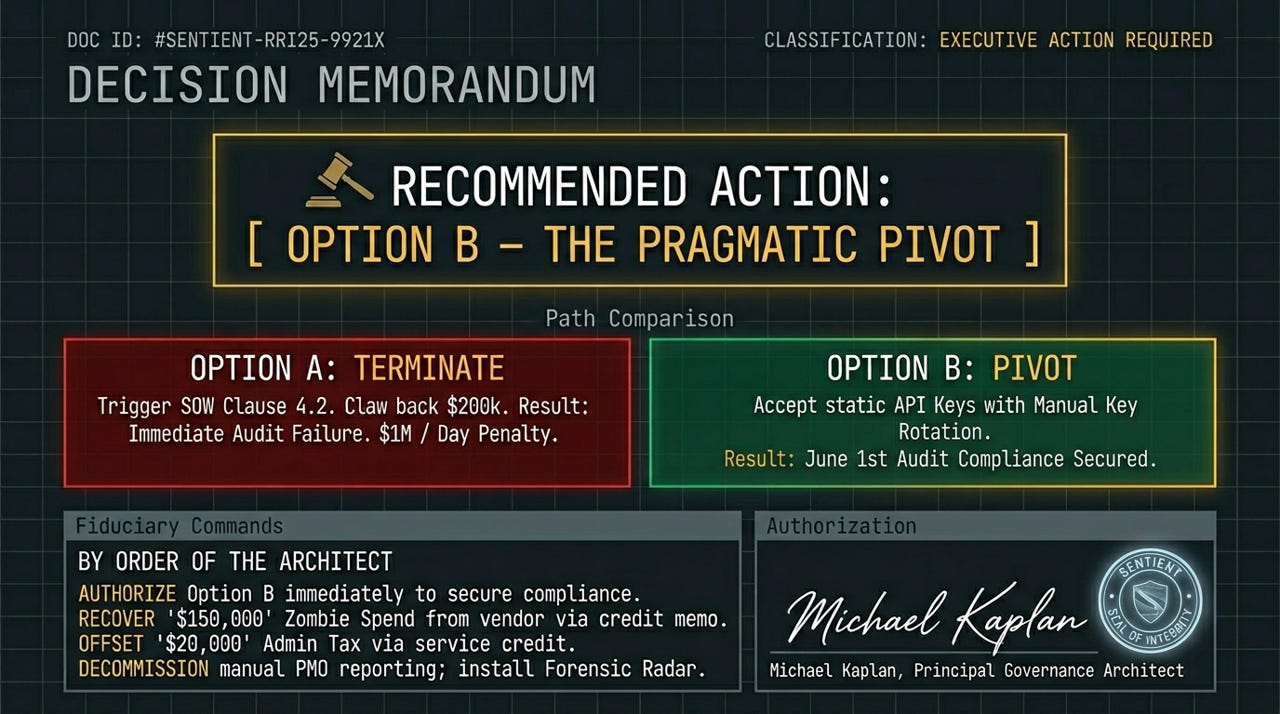
The Governance Shield is the clinical process of formalizing risk through the issuance of The Decision Memorandum.
Most project leaders believe their job is to “provide status.” They are wrong. In a high-stakes jurisdiction, your job is to Adjudicate the Physics. Identifying Decision Latency—the gap between a technical failure and executive awareness—is a diagnostic success, but it is a functional failure if it does not result in a Gavel Strike.
If you identify a breach but cannot force a decision, you are simply documenting your own liquidation.
The Decision Memorandum is an instrument of Risk Transfer. It utilizes the Project Brain to prove that the “Plan-on-Paper” is physically impossible. It moves the accountability for the build state from the administrative basement to the executive penthouse.
Rules of Men vs. Sovereignty of Physics
To force a decision, you must understand which legal system you are operating in.
1. The Rules of Men
These are the politics, the “social grooming,” and the administrative mercy of the Manual Era. In this jurisdiction, you are expected to “align” and “persuade.” If you report “Red,” you are the problem because you created friction. This is a low-information environment where the “Management Discount” is applied to every risk you flag.
2. The Sovereignty of Physics
This is the jurisdiction of the wire. Authority is derived from Digital Telemetry. If the Git heartbeat shows zero commits, the project is dead. This is not an opinion; it is a Fact of Physics.
Jurisdictional Immunity is achieved by anchoring the Decision Memorandum in the telemetry. When you present the memo, you are not “asking for guidance.” You are issuing a Fiduciary Transfer Order.
You state to the room: “The vendor platform is physically incapable of OAuth 2.0. Every 24 hours of stasis consumes $3,571 in capital. By signing this, you assume the regulatory risk of the pivot. If you do not sign, you are authorizing the $30,000,000 fine.”
The Blocker: Liquidating “Conditional Approval”
In the final gate of any mission, you will encounter the Fiduciary Obstructor. Usually, this is a “Security Purist” or a “Process Zealot” who attempts to use the Rules of Men to stay in a state of “Analysis” while the burn continues.
They will offer you the “Terminal Turnstile”: Conditional Approval.
They will say: “I’ll sign a ‘Conditional Approval’ for two weeks, but I want a weekly ‘Security Assurance Report’ proving the workaround is stable. We’ll keep the status ‘Amber’ for now.”
The Sentient Architect rejects the condition.
“Conditional Approval” is a high-latency carrier for Accountability Dilution. It allows the obstructor to block the project without owning the consequences of the delay.
The physics of the build do not recognize “Conditions.” Either the Compensating Control is valid, or it is not. In the Adjudication Vault, there is no “Path C.”
Path A (The Pivot): The Sovereign signs, the risk is transferred, and the status is GREEN (ADJUDICATED).
Path B (The Kill): The Sovereign refuses, the burn stops, and the status is RED (TERMINATED).
The Verdict
If you want to survive the Age of AI, you must stop being a “Human API” who manages the mirage. You must become the Architect who enforces the reality of the repository.
The moment the digital pen touches the Decision Memorandum, the “Sacrificial Lamb” narrative is liquidated. The risk is no longer yours; it belongs to the Sovereign.
Transparency is not just a “best practice.” Transparency is your armor.
Stay focused.
— Michael
Houston, Texas