
When Vulnerability Discovery Costs $225, Governance Is the Bottleneck

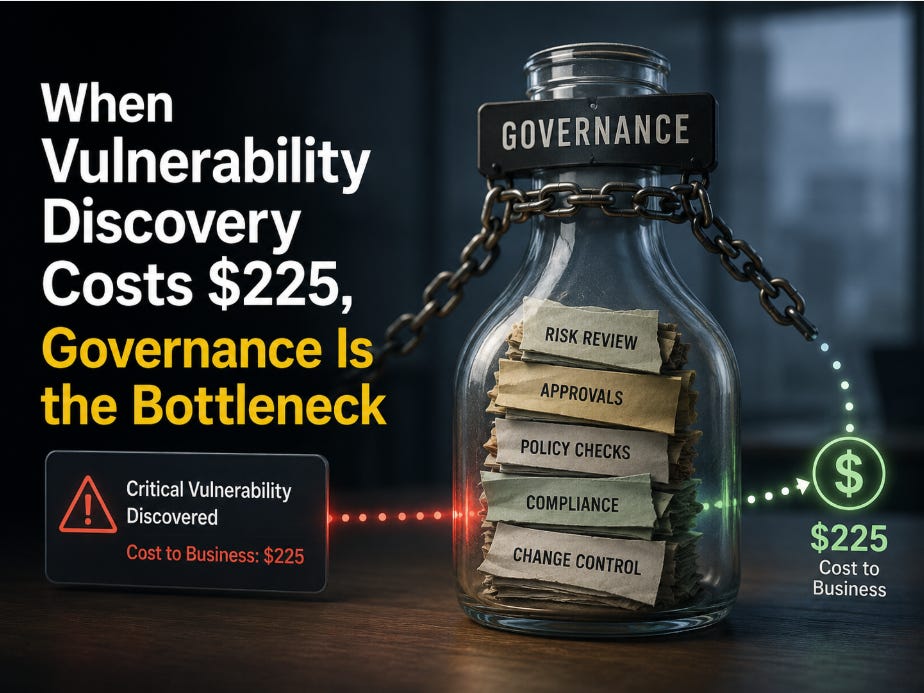
A striking metric recently surfaced in the offensive cybersecurity world: an autonomous AI security agent, engineered by Tenzai, reached elite-level hacking performance across multiple platforms simultaneously, outperforming more than 125,000 human security researchers. It identified, validated, and successfully submitted real, confirmed software vulnerabilities to HackerOne at an average cost of just $225 per vulnerability.
For anyone managing enterprise risk, that figure should make your hands sweat. But the cost collapse isn’t even the most significant part of the equation.
Getting a vulnerability accepted on an elite bug bounty platform like HackerOne requires far more than running a basic automated scan. The AI agent had to dynamically determine whether what it uncovered was an active flaw or designed behavior, build a credible impact narrative, and produce a high-fidelity technical report that a human security researcher at another company would accept as valid. It required context, reasoning, and the ability to convert raw data into trusted human judgment.
This milestone points to a massive, impending shift that extends far beyond the boundaries of cybersecurity. If AI agents can continuously hunt a codebase for logic flaws, weak assumptions, and structural vulnerabilities, we are asking the wrong question if we only apply this technology to code. We must apply this exact same telemetric paradigm to how we assess and audit large-scale enterprise projects.
The Mismatch: Codebases vs. Project Repositories
Right now, most corporate executives are using generative AI for basic administrative summarization—asking it to write prettier status reports, summarize a meeting transcript, or audit a single, static project plan. This is a massive waste of the technology’s cognitive potential. A project plan is just one isolated, highly sanitized document of intent. Real enterprise risk does not live inside the formatting of your Gantt charts; it lives across the entire, unstructured digital exhaust of the operation.
The future of capital protection is not AI-generated status reporting. The future is AI-Assisted Project Vulnerability Hunting.
The analogy is simple: a code vulnerability is an exploitable weakness between what the software is supposed to do and what it actually permits. A project vulnerability is an exploitable weakness between what the corporate narrative claims and what the unedited physical telemetry of the build supports.
When you configure an agent to hunt across a project’s entire data repository—SOW boundaries, actual schedules, unedited meeting summaries, financial ledgers, and codebase commits—it doesn’t ask “Does this look good?” It hunts for structural, balance-sheet vulnerabilities:
Narrative Vulnerabilities: Exposing the classic “watermelon project” where the steering committee deck claims GREEN / ON TRACK, but the underlying developer logs, technical summaries, and side-channel transcripts reveal unresolved architectural blockades.
Assumption Vulnerabilities: Identifying where an enterprise is continuing to capitalize millions in developer labor under SOP 98-1 on a business case whose underlying technical or market baselines were completely invalidated two quarters ago.
Decision Vulnerabilities: Spotting critical design tradeoffs or vendor roadblocks that leadership believes are being resolved, but the governance log reveals are simply being renamed, deferred, and kicked down the road as “action items” across multiple review cycles.
The Cyber-Physical Parallel: Lessons from the Utility Grid
This telemetric approach is not a theoretical framework. It is an engineering discipline I have had to enforce in highly secure, critical infrastructure environments.
When I directed the turnaround of a distressed $25M+ cybersecurity and GRC portfolio in a regulated NERC CIP utility environment, we encountered the limits of manual, human-attested status reporting. To establish true program assurance, we orchestrated the strategic pivot from manual, high-latency security testing to automated adversary simulation using SafeBreach.
The lesson was clear: when you use automated agents to actively probe your network boundaries, you expose critical vulnerabilities that manual, high-status checklists miss entirely.
The exact same design transition must now occur in capital governance. We must translate cyber-defense infrastructure into capital-assurance terms:
The Ingress Telemetry: In cyber, this is your raw logs, API handshakes, and system commits. In project governance, it is the unstructured digital exhaust of daily work—meeting summaries, email threads, and change logs.
The In-Tenant Refinery: Instead of triaging code bugs, a localized AI agent ingests that digital exhaust inside your secure corporate firewall, discarding the conversational noise and validating raw work data into structured, chronological state mutations (the project_ledger.log).
The Project Brain: Much like a security SIEM compares a newly discovered CVE against asset criticality, the Project Brain serves as the reasoning layer—comparing real-time technical delivery signals against original SOW boundaries and financial allocations.
The Governance Shield: The ultimate decision record. In cyber, it is your secure patch log; in capital assurance, it is the documented evidence of exactly what was known, when it was known, and why a specific capital path or risk was accepted.
The Ultimate Bottleneck: Truth Latency
When the cost of discovering technical and structural vulnerabilities collapses to $225, the bottleneck shifts entirely. The problem is no longer discovering risk; it is human decision latency.
Enterprises already struggle to act on ordinary project signals and obvious status-report contradictions. When AI begins exposing hidden operational realities at machine speed, it will create massive signal overload.
If your AI agents are detecting technical stasis and vendor slippages in 24 hours, but your steering committees still require three weeks to schedule an alignment huddle, your technical capability has completely outrun your governance speed. That delay is Truth Latency.
The question for enterprise leaders is no longer whether you can find out if your major systems integrations are failing. The data is already there, buried in the digital exhaust of your daily operations.
The question is whether you are willing to move past the era of the polished status report, and start hunting for the vulnerabilities in your execution before they become multi-million-dollar write-offs.
The empty room is where the fiduciaries work.